Why I Started Qigong for Daily Body Tune-Ups — And Never Looked Back
You don’t need hours at the gym to feel balanced and energized. I used to think body maintenance meant intense workouts or strict diets—until I discovered qigong. In just minutes a day, this quiet practice transformed how I move, breathe, and feel. It’s not magic, just mindful motion rooted in traditional Chinese wisdom. If your body feels stiff, tired, or out of sync, this simple routine might be exactly what you’ve been missing.
The Wake-Up Call: When My Body Said “Enough”
For years, I treated my body like a machine I could push without maintenance. Long hours at a desk, constant multitasking, and the endless demands of family and work left me drained. At first, I dismissed the signs—morning stiffness, afternoon fatigue, restless nights—as normal parts of aging or just being busy. But over time, the discomfort became harder to ignore. My shoulders stayed tight no matter how many hot showers I took. My lower back ached after standing for just a few minutes. Even on weekends, I felt more sluggish than refreshed.
I tried the usual fixes: over-the-counter pain relievers, occasional stretching, and weekend bursts of intense exercise. But the relief was always temporary. The stiffness returned, the fatigue deepened, and I began to notice a mental fog that made it hard to focus or stay present with my loved ones. I wasn’t just physically worn out—I felt disconnected from my body, like I was running on autopilot.
It wasn’t until a routine doctor’s visit that I realized something had to change. My blood pressure was slightly elevated, and my doctor gently suggested that stress and inactivity were taking a toll. She didn’t prescribe medication but encouraged me to find a sustainable way to support my body’s natural balance. That conversation planted a seed. I began reading about holistic wellness and stumbled upon qigong—a practice I’d heard of but never understood. Unlike aggressive workouts or complicated regimens, qigong was described as gentle, accessible, and rooted in centuries of observation about how the body truly functions. For the first time, I considered that healing might not require force, but attention.
What Exactly Is Qigong? (And Why It’s Not Just “Slow Exercise”)
At its core, qigong (pronounced “chee-gong”) is a practice that unites breath, gentle movement, and focused intention to support the body’s natural energy flow. The word itself comes from two Chinese terms: *qi*, meaning vital life force or energy, and *gong*, meaning cultivation or practice. Together, qigong translates to “cultivating energy.” But it’s important to understand that this isn’t about mystical forces or supernatural powers. In the context of traditional Chinese medicine, *qi* refers to the physiological and energetic processes that keep the body functioning—circulation, nerve signaling, cellular regeneration, and the subtle rhythms of breath and movement.
Qigong is often mistaken for slow exercise or a form of meditation you do while standing. While it shares elements with yoga, tai chi, and mindfulness, its unique focus is on internal regulation. Every movement is coordinated with the breath and guided by awareness. For example, raising the arms isn’t just a physical act—it’s done slowly, with attention to how the shoulders relax, how the breath deepens, and how the mind stays present. This combination of motion, breath, and mindfulness creates a feedback loop that helps the nervous system shift from stress mode to rest-and-repair mode.
Unlike high-intensity workouts that break down muscle to build strength, qigong works by enhancing the body’s efficiency. It’s preventive care, not crisis management. Think of it like tuning a piano: you don’t wait for the strings to snap before adjusting them. Regular, gentle practice keeps the body’s systems in harmony. In traditional Chinese medicine, qigong has been used for thousands of years not to treat disease, but to maintain balance and support longevity. It’s considered a daily ritual, much like brushing your teeth—simple, essential, and profoundly effective over time.
Why “Quick” Qigong Works for Real Lives
One of the biggest barriers to wellness is the belief that it requires hours of time, special equipment, or a complete lifestyle overhaul. Many of us assume that if we can’t commit to a 45-minute workout or a strict diet, we’re not doing enough. But qigong challenges that mindset. The truth is, even 5 to 10 minutes of focused practice each day can lead to meaningful changes—especially when done consistently.
I started with just three minutes in the morning. No mat, no special clothes, no playlist. I simply stood by my bedroom window and followed a simple sequence I learned online. At first, I didn’t notice anything dramatic. But within a week, I began to feel a subtle shift. My morning stiffness eased. I caught myself standing taller. My breath felt deeper, especially when I was stressed.
What makes short qigong sessions so effective is their ability to interrupt the body’s stress patterns. When we’re stuck at a desk or caught in traffic, our breathing becomes shallow, our muscles tense, and our nervous system stays on high alert. A brief qigong practice acts like a reset button. It signals the body that it’s safe to relax, that it doesn’t have to be in survival mode. Over time, these small resets accumulate. They improve circulation, reduce muscle tension, and support mental clarity. The beauty is that it fits into real life—before breakfast, during a work break, or while waiting for dinner to cook. You don’t need a studio or a schedule. You just need the willingness to pause and pay attention.
My Go-To 3-Minute Routine for Daily Reset
When I first started, I looked for routines that were simple, repeatable, and easy to remember. After trying several, I settled on a three-part sequence that I now do almost every day. It takes less than three minutes, requires no equipment, and can be done almost anywhere—my kitchen, a quiet corner at work, or even in an airport terminal.
The first step is **Gentle Neck Rolls**. I stand with my feet shoulder-width apart, knees slightly bent, and spine tall. I slowly tilt my head to the right, bringing my ear toward my shoulder, then roll it forward, to the left, and back. I do this for about 30 seconds, moving with my breath—inhaling as I tilt up, exhaling as I lower. This simple motion releases tension that builds up from looking at screens or holding stress in the neck.
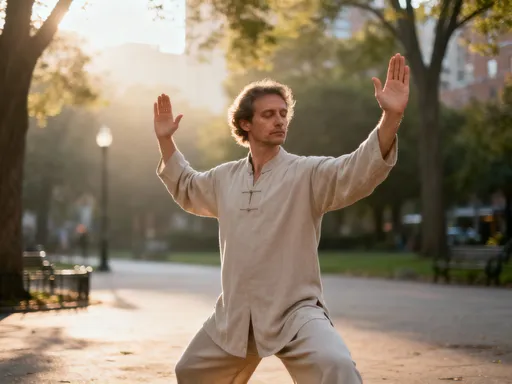
The second step is **Rising Hands with Breath**. With my arms at my sides, I inhale slowly through my nose, raising my hands in front of me, palms up, all the way to shoulder height. As I exhale through my mouth, I lower them back down, palms turning down as they descend. I repeat this four to six times, keeping my movements smooth and my breath deep. This motion stimulates energy flow along the arms and helps regulate the breath, which in turn calms the mind.
The third and final step is **Standing Like a Tree**, a basic *Zhan Zhuang* posture. I stand still, feet rooted, knees slightly bent, hands held in front of my lower abdomen as if cradling a ball. I focus on my breath and the sensation of being grounded. I don’t try to “do” anything—just stand and be present. Even this brief moment of stillness helps me reconnect with my body and reset my nervous system. The key isn’t perfection; it’s showing up. This routine isn’t about performance. It’s about practice—daily, gentle, and kind.
How It Actually Feels: The Subtle Shifts That Add Up
One of the most surprising things about qigong is how much you can feel—without doing very much. In the beginning, I expected dramatic changes: instant energy, pain relief, or deep emotional release. But what I experienced was quieter, more gradual. After a few weeks, I noticed that my hands often felt warm during practice, even in a cool room. My breath became deeper without me trying. My posture improved—not because I was forcing it, but because my body naturally found better alignment.
I also began to sleep more soundly. Falling asleep used to take me 30 minutes or more, with my mind racing through the day’s tasks. Now, after an evening qigong session, I drift off more easily. I wake up with less stiffness and more clarity. The aches in my shoulders and back haven’t vanished completely, but they’re less frequent and less intense. I’ve also become more aware of tension as it builds—catching myself clenching my jaw or hunching my shoulders—and I can release it with a few mindful breaths.
These changes didn’t happen overnight. They accumulated over weeks and months of consistent, small efforts. But that’s the power of qigong: it works with the body’s natural rhythms, not against them. It doesn’t force transformation; it invites it. And because the practice is so gentle, it’s sustainable. I don’t dread it like I once did with intense workouts. Instead, I look forward to it—a quiet moment of care in a busy day. It’s not about fixing what’s broken. It’s about honoring what’s already working and giving it the support it needs to thrive.
Science Meets Tradition: What Research Says About Qigong’s Benefits
While qigong has been practiced for thousands of years, modern science is beginning to validate what traditional practitioners have long observed. Studies published in peer-reviewed journals have shown that regular qigong practice can lead to measurable improvements in both physical and mental health. For example, research has found that qigong can reduce levels of cortisol, the primary stress hormone, leading to lower anxiety and improved mood. Other studies have demonstrated improvements in balance and coordination, which is especially beneficial for older adults looking to prevent falls.
A 2019 meta-analysis published in the journal *BMC Complementary Medicine and Therapies* reviewed multiple clinical trials and concluded that qigong had a positive effect on sleep quality, particularly for individuals with chronic insomnia. Another study from the *Journal of Alternative and Complementary Medicine* found that participants who practiced qigong for eight weeks reported significant reductions in lower back pain and increased functional mobility. These benefits were observed with sessions as short as 20 minutes, three times per week.
The National Institutes of Health (NIH) recognizes qigong as a form of mind-body practice that may support integrative health approaches. While it’s not promoted as a cure for medical conditions, it’s increasingly included in wellness programs for its ability to complement conventional care. For instance, some hospitals now offer qigong as part of cardiac rehabilitation or cancer support programs to help patients manage stress and fatigue.
What’s clear from the research is that qigong works best as a long-term, consistent practice. Benefits are not immediate or dramatic, but they are real and cumulative. Unlike quick-fix solutions that promise instant results, qigong supports the body’s innate ability to self-regulate. It’s not about replacing medical treatment, but about creating a foundation of balance that allows the body to heal and function more effectively. The science doesn’t contradict tradition—it confirms it.
Making It Stick: How to Weave Qigong Into Your Day Without Thinking
The biggest challenge with any new habit isn’t starting—it’s sticking with it. I’ve learned that the key to making qigong a lasting part of my life is simplicity and integration. I don’t treat it as another task on my to-do list. Instead, I attach it to existing routines. For example, I do my 3-minute practice right after I brush my teeth in the morning. It’s become as automatic as washing my face. On busy days, I might do just one posture—Standing Like a Tree—while my coffee brews.
I also use small cues to remind myself. I set a gentle notification on my phone for midday, labeled “Pause and Breathe.” Sometimes I practice during commercial breaks while watching TV in the evening. The goal isn’t to do a perfect session every time, but to stay connected. Even 60 seconds of mindful breathing counts. Over time, these moments add up.
I’ve also learned to be patient and kind to myself. There are days when I skip practice, and that’s okay. Qigong isn’t about discipline in the rigid sense. It’s about care. When I return to the practice, I don’t judge myself. I simply begin again. This mindset has helped me stay consistent without burnout. I’ve come to see qigong not as an obligation, but as a gift—a daily act of self-respect. It reminds me that my body is not just a tool for getting things done, but a living, breathing system that deserves attention and kindness.
For anyone considering qigong, my advice is to start small. Choose one simple movement or posture. Practice it at the same time each day. Don’t worry about doing it “right.” Focus on showing up. Let the benefits unfold naturally. You don’t need to believe in energy or ancient wisdom to experience the results. Just breathe, move gently, and pay attention. That’s enough.
Qigong isn’t about perfection—it’s about presence. By dedicating just minutes a day to mindful movement, you’re not just maintaining your body; you’re honoring its wisdom. In a world that glorifies speed, this ancient practice teaches us that slow, steady care often brings the deepest change. Try it not for dramatic results, but for the quiet strength it builds—one breath at a time.